Start with the shore, not the villa
On Lake Como two similar houses can lead opposite lives. The shore changes, the aspect changes, the stretch of lake changes: the mountains behind may take the winter sun away much earlier than one imagines, and a busy road under the windows can be heard even with the glass closed. A lakeside villa is bought with the ear as well as the eye: the passing of the ferries, the noise of the road, the water against the retaining wall say more than a floor plan. For this reason we recommend seeing it at two different times, one morning and one late afternoon, and passing by at least once on a weekday at rush hour.
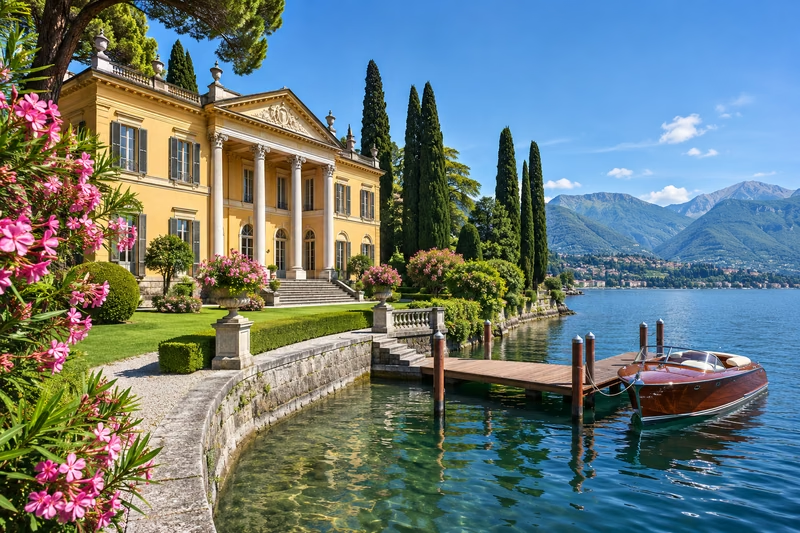
Jetty, boathouse and water
For many buyers the jetty is the very reason for the purchase, and it is the part that needs most attention. Check:
- whether there is a concession for the jetty or boathouse, who holds it, when it expires and on what terms it passes to a new owner: transfer is not always automatic;
- the condition of the retaining wall and of the steps down to the water, which need upkeep over time;
- the lake level, which varies through the year and may come close to gardens and low-lying rooms;
- the depth of the water and the real possibility of mooring, if you own a boat.
Restrictions and permits
Much of the shoreline is protected by a landscape restriction. In practice, any change visible from outside, from the colour of a façade to a pergola or a swimming pool, needs authorisation. What can be done depends on the municipality and on the restriction, and the answer comes from a technician who knows the offices, not from a guess. If the villa has been declared of historic interest, the rules are stricter and involve the heritage authority, the Soprintendenza.
The condition of the building
A period villa on the water suffers from damp, from changes in temperature and from terraces that shift. Before making an offer it is worth having the following checked:
- the roof, the gutters and the retaining walls of the terraced gardens;
- the systems, often updated piecemeal in different decades;
- windows and glazed doors, which, when original, are restored rather than replaced;
- cellars and basement rooms, where damp shows itself first.
Road, parking and daily life
A beautiful house reached by a narrow lane with alternating one-way traffic becomes tiring. It is worth driving the route towards Milan or the border at different times, looking for space for two cars, walking down to the lake with the shopping. It is a test that no photograph can carry out on the buyer's behalf.
The road to the deed
After choosing the villa, title deeds, floor plans, concessions and restrictions are checked; then come the offer, the preliminary contract and the deed at the notary's office. Timing depends on the landscape procedures and on how complex the titles are, and nobody can guarantee it. For foreign clients our team brings in an interpreter and, where possible, a notary who speaks their language.
Four questions to ask before viewing
- Who were the last owners and why are they selling?
- Does the registered floor plan match the house?
- What works have been carried out in recent years, and with what authorisations?
- What does it cost to keep the villa in order in an ordinary year?
Rules change and every case has its own particulars: before committing, it is wise to speak to the notary and to a technician you trust.